

In the Beginning was the Word. I have always soaked up random knowledge like a sponge, which explains a slavish devotion to University Challenge, (pride in my infinitesimal contribution of right answers), and perhaps the contents of this blog. If books remain forever my first love, radio, or “the wireless”, runs a close second. According to Nietzsche life without music would be a mistake. He’s right of course, but for me music is supplementary to the written or spoken word. Sorry Kevin.
Back in 1945 everything changed from my “normal”, to something other; the adults around me were less anxious, though not entirely satisfied as they were hoping to “get back to” another “normal”, somewhere in the mysterious land of “Before-the-War”. For six years Dad had nurtured a longing for custard cream biscuits, which was eventually satisfied, a torchlight beam along this stumbling journey, as was the resumption of the Shipping Forecast, which had been suspended, 1939-45.
The wireless was usually turned on when we were sitting down, otherwise it interfered with “getting on with your work”, a concept with which I have always had difficulty. Our downstairs space consisted of three rooms, the tiny “back kitchen”, the “kitchen” the only room with a fire, where we mostly lived, and the “front room”, kept tidy for unexpected visitors.
Here you can picture the four of us big, medium, minor and tiddly, (my two-year-old brother), either all at the kitchen table or Mum or Dad on the ‘fireside chairs’, Colin playing on the rag mat in front of the fire guard, with me on one of the ‘boxes’, padded seats that were part of the furnishings of the grate. Dad twiddled the wireless knob to avoid sundry flak, Hilversum, Belgrade, Luxembourg, and the rest, which I compulsively read on the illuminated dial, waiting for The News, (sacrosanct), to come on.
 The Shipping Forecast was regularly broadcast at advertised times, but my recollection is clearer of ‘the unexpected’: a dramatic interruption of transmission at any time for “Attention All Shipping! This is a Gale Warning!” announced in the serious, authoritative tones Mum thought of as “a peaked cap voice”, i.e. someone, a man, you must always obey. The next sentence drew me fully in:
“South Cones are being hoisted at Sea Areas ……” (as appropriate) “… Lundy, Fastnet, Irish Sea, Shannon, Rockall, Malin, Hebrides…………”
Even aged eight, I cottoned on to this roster of places, but I could never fathom what a South Cone was. Nobody in the household knew either. “Thee dost want to know everything,” Dad would say, on the few times he couldn’t supply the answer to one of my many questions. Until now, I stayed mystified. A South Cone was like trying to imagine God, a grey cloudlike whisp, forever just out of sight.
The internet has helped me out after all this time.
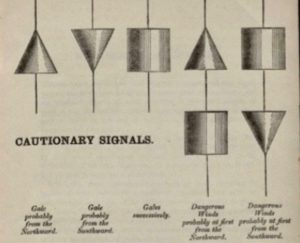 Southern & Northern Cones: A cone pointed downward indicated gale-force winds were expected from the south; a cone pointed upward indicated gale force winds expected from the north. A “lampshade” meant be prepared for a hurricane. Other variations as indicated.
The system was devised by Robert Fitzroy, FRS, whose first claim to fame was as the captain of HMS Beagle, the ship which took Darwin round the world. The voyage eventually led to the publication of “The Origin of Species”, which threw Fitzroy into turmoil. He said it had caused him “the acutest pain.” He regretted the part he had played in the enterprise. I had imagined him and Darwin having cosy chats in the captain’s cabin, though it seems I was wrong.
Fitzroy had a distinguished career in the Royal Navy , eventually advanced to Vice-Admiral, 1863) which included the sometime Governorship of New Zealand.
His final incarnation was as a pioneer meteorologist.
In 1860, he introduced the storm warning system of Cones and his volume “The Weather Book” published in 1863 was far in advance of the meteorology of its time; he was even contacted by Queen Victoria for a prediction before she braved the crossing to her holiday home on the Isle of Wight. The very word “forecast” was coined by Fitzroy. He ordered that ships should not put to sea if dangerous conditions were expected and thus became a hero to sailors and fishermen for the many lives thus saved; the idea was predictably not popular with the owners of fishing fleets.
Towards the end, Fitzroy struggled with depression, financial trouble, criticism of his forecasts and personal grief; he lost his wife and his 16-year-old daughter in quick succession. His difficulty of reconciling Darwin’s volume with his deeply held Christian beliefs cannot have been much comfort. In 1865 he took his own life. For a short while after his death, his scheme of gale warnings was abandoned, (which seems to me like the shame of suicide by association) and the fleets once again put to sea in adverse conditions. Pressure by fishermen led to the system being reinstated in 1874.
One sea area I thought of as particularly ominous was “Finisterre”; would it have sounded less so if I had known then it was simply the French for Land’s End? I don’t know, but to me it sets off a shiver, the muffled boom of a foghorn in pitch black darkness, with the Knell of Doom about it.
Finisterre was renamed “Fitzroy” in 2002. Though quite possibly, he and I would have clashed, (as if I would have dared!) as he often did with Darwin, I am pleased that he was rewarded with a Sea Area.
His gravestone is inscribed:
“The wind goeth toward the south,
and turneth about unto the north;
it whirleth about continually,
and the wind returneth again
according to his circuits”
Ecclesiastes 1.6.
Cones were still being hoisted at ships and coastal stations up to the 1980s.
At this time, I only knew ships from books, John Cabot, Nelson, or at Sunday School when we sang “For those in Peril on the Sea”; this was despite living on the edge of Bristol, in bygone times one of the foremost ports in the land. I had seen the sea. I had paddled in it, but at that time I was not even two and could not remember it. The sea areas were only known to me by the wireless, but like a later appreciation of art, I knew if something was good; that the names were not rum-tee-tum, but proper poetry.
Then, isn’t it great when in time to come you find your thoughts shared by a genius?
Dogger, Rockall, Malin, Irish Sea:
Green, swift upsurges, North Atlantic flux
Conjured by that strong gale-warning voice,
Collapse into a sibilant penumbra.
Midnight and closedown. Sirens of the tundra,
Of eel-road, seal-road, keel-road, whale-road, raise
Their wind-compounded keen behind the baize
And drive the trawlers to the lee of Wicklow.
L’Etoile, Le Guillemot, La Belle Hélène
Nursed their bright names this morning in the bay
That toiled like mortar. It was marvellous
And actual, I said out loud, “A haven,”
The word deepening, clearing, like the sky
Elsewhere on Minches, Cromarty, The Faroes.
Glanmore Sonnets VII, taken from Field Work by Seamus Heaney, published by Faber and Faber Ltd.
In my middle years I didn’t pay much attention to the shipping forecast, and it was only in semi-dotage after I had a bed-side radio that I came back to it. The new radio combined with George’s deafness (It’s an ill-wind – to use an appropriate but unfortunate seafaring metaphor – which blows nobody any good) allowed me to listen and then leave the thing on all night – which I still do – to combat chronic insomnia. At the time this nighttime ritual began, I worried what had happened to Heligoland, an imagined fairyland which was gone, obviously sunk below German Bight, which my mind’s eye sees as a more menacing Chesil Beach. But Heligoland is still there – now part of Schleswig-Holstein, of all places, the scene of complicated 19th century wars, which I wrestled with when writing the saga of the Lindegaard family.
One year “Attention All Shipping”, by Charlie Connelly, appeared in my stocking, not courtesy of Santa, but placed there through our son’s perspicacity. It relates the tale of the author’s “Journey Round the Shipping Forecast”. It’s a great idea. If only I’d thought of it. Our version followed as inevitably as day follows night.
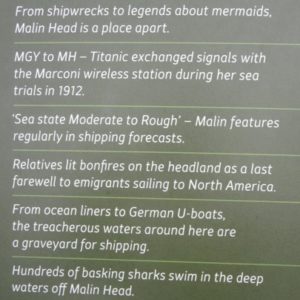 In October 2018, with George and Kevin at Ireland’s most northerly point: Sea Area Malin. My diary doesn’t say much: “up to Malin Head, wild and windy, with spectacular scenery.” I didn’t write a blog then. (Kevin sighs with relief.)
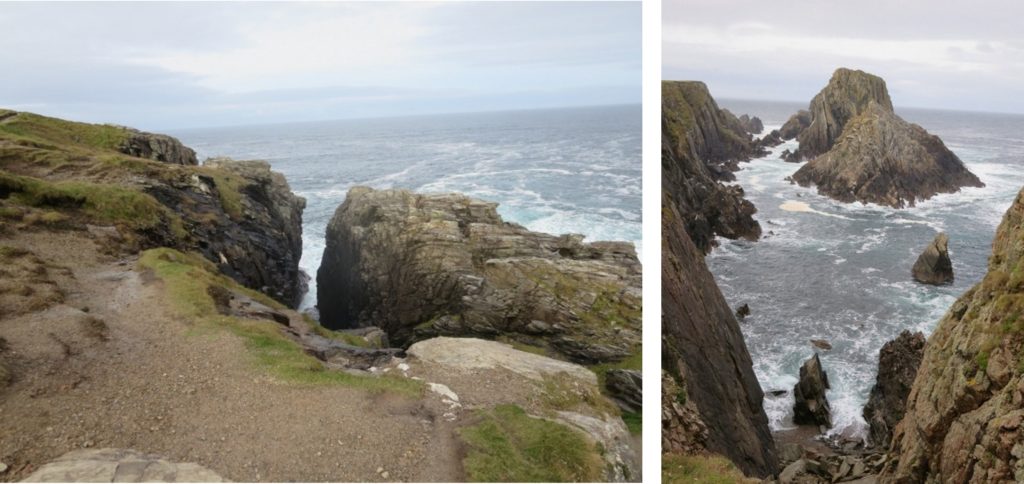
The sea was “Moderate to Rough” as the notice board says. The day grey and overcast and we had the place to ourselves apart from a young couple with a baby in a buggy with whom we shared a few pleasantries. The Lloyd’s Signal Tower, now a boarded-up ruin, was built in the 19th century to warn incoming ships of changing weather and dangerous conditions. (“North Cones are being hoisted …….. ?”) The treacherous waters here are “a graveyard for shipping.”
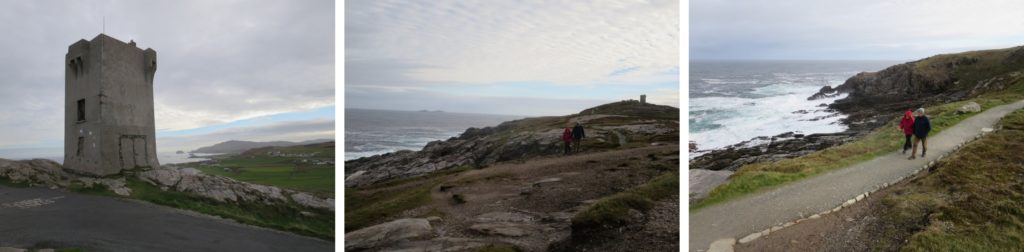
Here we are setting off with the Signal Tower in the far background….
Kevin moved on to more rugged terrain.
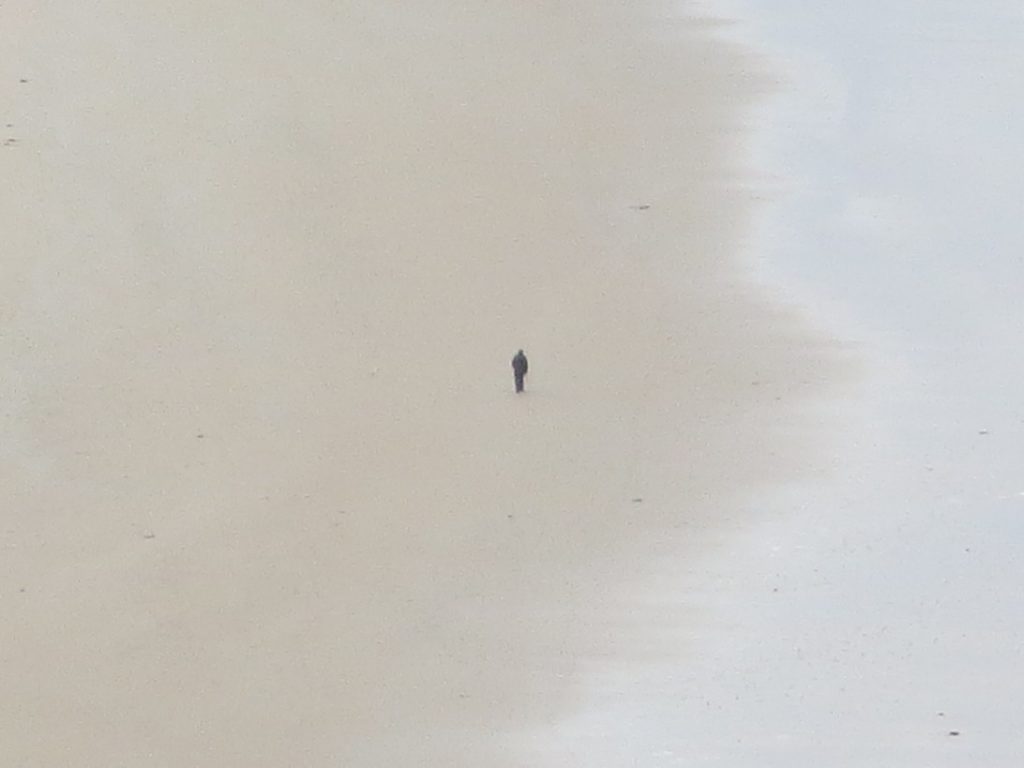
On another day and a more benign beach we spied a lonely walker, far below, someone who marches to the beat of a different drum.
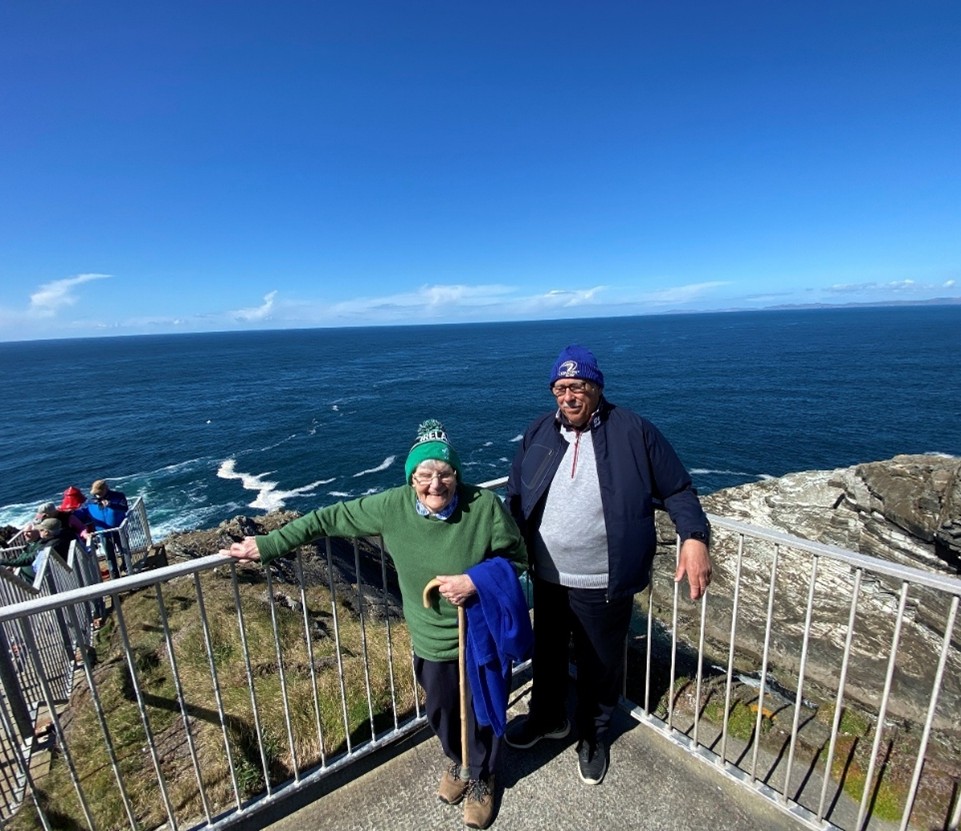
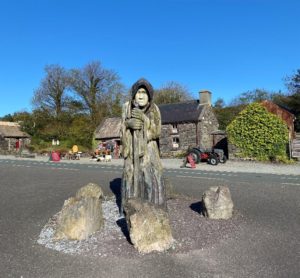 Here we are back in 2025, and driving towards our last destination, Mizen Head: Sea Area Fastnet. We came upon this oddity, but sadly did not have time to stop other than take a photo. Note the cloudless blue sky. “Oh, to be in” – ahem, Ireland – “now that April’s there.”
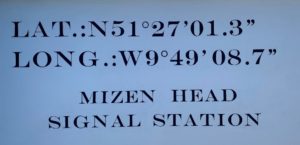 The original Footbridge to the Mizen Head Signal Station, completed in 1910, lasted nearly one hundred years. It was closed overnight in 2005 as soon as engineers discovered potentially disastrous anaerobic disintegration in the reinforced steel. The bridge was demolished and reconstructed 2007-2010 and reopened in 2011. For the fully illustrated story of this remarkable feat of engineering endurance, see https://mizenhead.ie/guide/mizen_displays/mizen-foot-bridge/
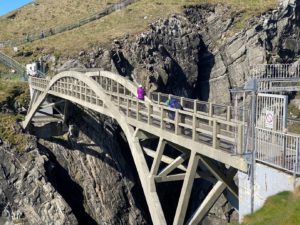 As the sightseers with binoculars show, dolphins, looking like spume in the photo, were frolicking in the background.
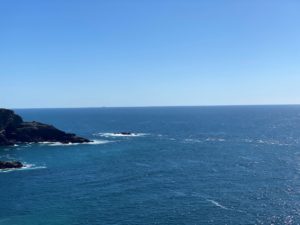
The Atlantic Ocean with Fastnet Rock & Lighthouse in the far distance

Fastnet appears many times in the newspapers……
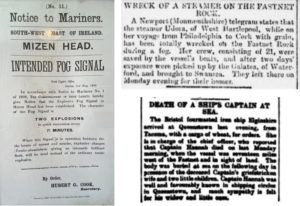 …the shipwreck in fog (Derby & Chesterfield Reporter, 23.6.1893) had a happy outcome …..
………though catastrophe at sea, (Evening Irish Times 25.10.1900), was not confined to weather or accident. A seaman was vulnerable to sudden illness and death even within sight of land. The tragic Captain Hannah would have known the Port of Bristol well. Cargo vessels plied regularly between the Bristol Channel and Cork. (Cuttings courtesy of Find My Past)
- I have written before about the notorious storm during the Fastnet Race, 13 August 1979.
See page 117, “Joe’s Story”, in “Sappho & her Sisters”, https://www.bristolhistory.co.uk/wp-content/uploads/sites/2/2021/03/sappho-and-sisters
On a lighter note, for the Bristol students on Lough Hyne in the 1950s, (see Day 2), a boat trip to Fastnet Rock was an annual event which one year they celebrated with a few lines of doggerel:
“The ordeal’s past. We’re back on land.
Dear Reader, please do try to understand
We really quite enjoy a swell
And it was nothing but the smell
Of petrol fumes that laid us low
We’re hardened sailors, don’t you know![1]
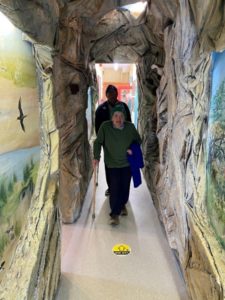
Here we are marching through the passages to inspect the Life of a Lighthouse Keeper. Luckily it wasn’t crowded. We didn’t notice we were going the wrong way…..!
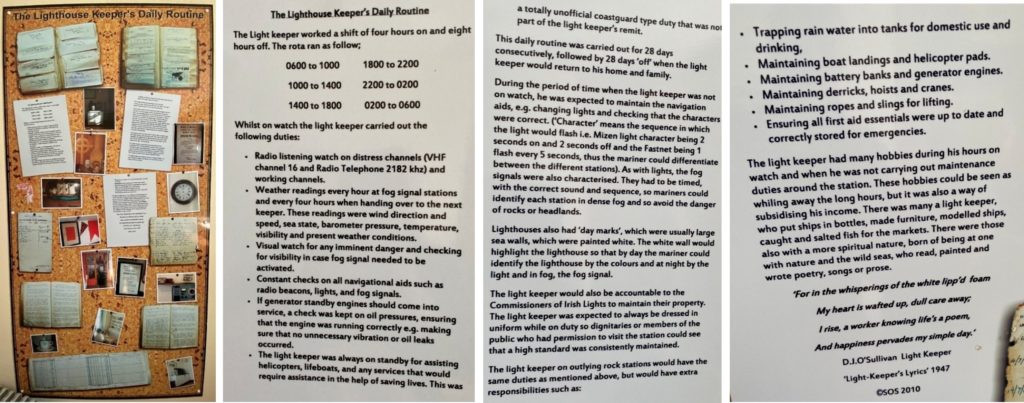
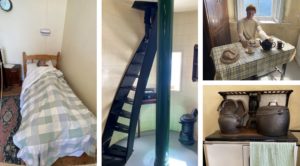
And for “the Bristol Link”, (Farnworth Chronicle, 24 Sept 1910), on a high:
“A wireless message received at Crookhaven from the Canadian Northern liner “Royal Edward”, bound for Bristol, off the Fastnet on Wednesday afternoon states that she has beaten all records for the passage from the Saint Lawrence by the all-British route, having covered the distance between Father Point and the Fastnet in five days 27 minutes. The best day’s run was 443 miles. On board are a party of Canadian and American journalists (who will tour the West of England at the invitation of the citizens of Bristol, Exeter and Plymouth), the returning band of the Canadian Grenadier Guards and the delegation from the Bristol Chamber of Commerce who have been touring Canada with a view to increasing trade with the West of England.
In 1910, just as it continues relevant today, “It’s the Economy, stupid”, a famous misquote of Jimmy Carville, strategist in Bill Clinton’s successful campaign, US Presidential Election, 1992.
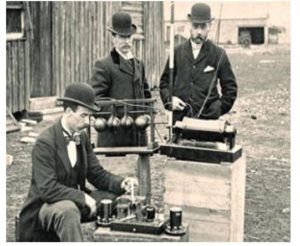 From Day One, the famous name of Marconi has followed us about. His is the first name which everybody knows on the subject of transatlantic wireless communication. I was no exception to the rule, but, as with Darwin and Alfred Russel Wallace, another great mind was simultaneously at work. He is identified only as “Preece” in the exhibition blurb which states “that Marconi established communication across the Bristol Channel where Preece was experimenting with indictive methods.” So let’s hear it for William Preece, FRS, a Welshman. This paper by Peter Lamb, https://wpehs.org.uk/wp-content/uploads/2019/01/Sup070 makes instructive reading.
Preece’s engineers experimenting in 1897, at Flat Holm, (which I need hardly say is in the Bristol Channel.)
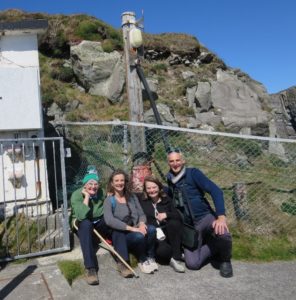
Me with Jen, Hope and Kevin
On the long trek back from the Head, we fell in with two very friendly American women who were in Ireland as members of a touring choir. We were struck with the synchronicity. Whilst Kevin bent the ear of Hope, concerning his forthcoming Bristol concert commemorating his hero, Aaron Copland, the American composer, I established a rapport with Jenn that can only be described as exceptional. It seemed we had been friends for years; in fact I adopted her as another daughter. We are still communicating months later, and maybe we will meet again one day.
Then it was a rush to get to the airport to get the hire car back on time and check in for our plane home. George and airports have a thing about each other. He must present as suspicious. The oldest terrorist in the world? A bomb in the audio appliance? Slight remainder of Irish brogue? The last not irregular here of course, but still, and not for the first time, he was asked to step aside.
En route by the wayside the lads had spotted a stall selling local honey. George and Honey go together like Paddington and Marmalade. We had to stop. Kevin jumped out and bought a jar. As we went through security an alarm sounded. George was arrested and escorted to a private room. He had forgotten the jar of honey in his pocket. He was patted down by two burly guards, who decided he was no particular risk, and with a warning to be more careful in future, they let him go but confiscated the honey. The attendant on the desk apologised. What we would we like her to do? They would destroy it or otherwise donate to a homeless shelter. A no brainer. Does anyone get so furious that they choose the former?
And so, we travelled home, and due to following wind the flight came in early. In fact, we arrived before our lovely Sheena, who was on pick up duty.
And so goodbye to all that, until the next time – Sea Area Lundy? possible for a day trip – but Sea Area Hebrides? Worth a punt? Does Brutus Tours Ltd cover Scotland?
[1] Page 35, Terri Kearney, Lough Hyne. See also https://www.bristolhistory.co.uk/2025/08/20/irish-odyssey-day-2-famine-
You May Also Like
Irish Odyssey Day 6, Part 2. ...
24 November 2025
Irish Odyssey Day 6, Part 1: ...
13 October 2025
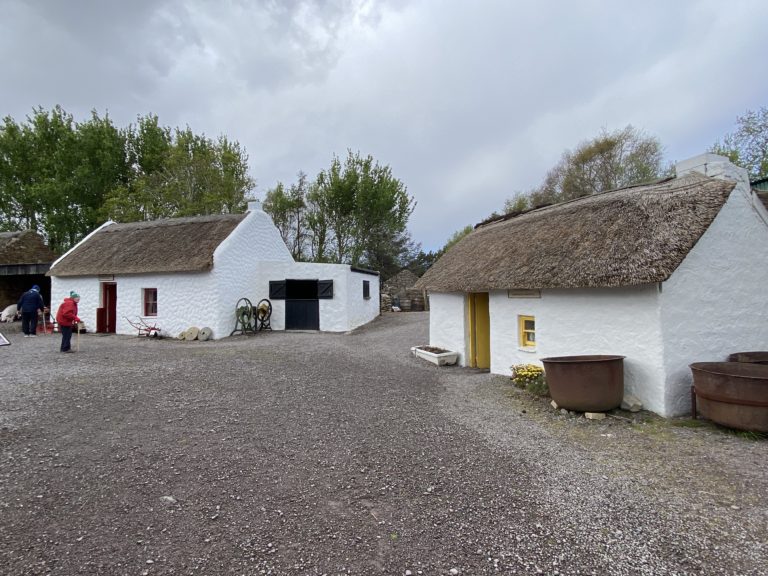
Irish Odyssey, Day 5: Pure N ...
21 September 2025
About Me
I have been researching the social history of the West Country for 50+ years. During this time I have collated information on a wide range of people living and working in the West Country including miners, ethnic minorities, petty criminals, sailors, tommies, benefactors, brassmakers and many more. The thing that I find amazing is that ordinary people always lived extraordinary lives. I hope you like my blog that brings together my lifetime of research.
Popular Post

Bristol Women – Helen Blackburn, 1842-1903
01 December 2025

TRANSPORTEES FROM GLOUCESTERSHIRE TO AUSTRALIA,1783-1842
09 November 2025

Leave a Comment