

On 16 June 2026, out of the blue, I received this email from the Girl Guides Association of St Lucia, an archipelago in the Caribbean.
Good day,
I do not wish to be a bother (you), but I’ve been trying to locate a photograph of Mrs Dorothy Vinter and wondered whether you could help me do so. I am reaching out to you because, like her you are involved in documenting the history of your community.
Mrs. Vinter started the Girl Guides in St. Lucia in 1925, and we would like to include a photograph of her in our 100th anniversary publication and possibly on a national stamp.
She is also the author of More Stories of Kingswood, The French Prisoners of Stapleton Jail, etc.
Thank you for any help you can provide.
Regards,
Lydia Charlemagne
Chief Commissioner.
I was delighted for a number of reasons: Foremost it is a relief that anybody takes the trouble to look at my blog and this time especially, in a part of the world I have never heard from before. Finally, I have “this thing”, a fascination with small islands. As to Dorothy Vinter, she and I go back many years though we never met.
The story begins in 1951, Festival of Britain Year, when I was fourteen. Most of the shops in Kingswood dolled up their windows with Union Jacks and all sorts of patriotic paraphernalia, (we weren’t ashamed of the British Empire then), but White’s the newsagents in Regent Street was different. Mr. White’s display was all about local history, of which the centrepiece was a dark brown book with gilt lettering which I was unable to read but a place card in front carried the macabre legend “Bound in the skin of a Kingswood murderer.” Time and again I was drawn back to the window to simply gaze. This was not HISTORY, writ large, as we were taught at school. (I am not about to reiterate the tragedy of John Horwood and Eliza Balsom, as it is well covered elsewhere The book can now be seen at Bristol’s M Shed Museum. Why Mr. White had it in 1951 is anybody’s guess.
In 1951 I had never heard of the story and longed to know more, but had no idea how to research anything, or even that the lives of “ordinary” people were documented at all. Help was available right in the corner of the window, if only I had grabbed the proffered hand: another book, almost pocket sized, only 20 pages long with stories of Kingswood’s history by Dorothy Vinter. I should have written to Dorothy there and then. Of course I should. But she was “the Doctor’s wife” and therefore “posh”. I was hampered by shyness and as an awkward working-class kid I was terrified of a rebuff. It makes me sound sad, but this is the way it was.
Fast forward nearly thirty years. I was a different character by then with lived experience the way young people now scroll. The Family History craze was in full swing. I borrowed Dorothy’s books from the library (they are rare as the proverbial hens’ teeth nowadays) and was particularly captivated by “Trapped in the Pit and other Kingwood stories”, (published 1951!) containing the tale of five young colliers, who survived five days and nights of incarceration in 1833. Dorothy also wrote dozens of articles for the Bristol Evening Post; I was trailing her, just as she had followed our predecessor, the antiquarian Rev Ellacombe of Bitton. But I still didn’t write to her. The chance discovery that a relative died in an accident at Easton Pit, led me to research my own book about the hundreds of other colliers who worked in the Kingswood mines, including Dorothy’s trapped boy miners. More years passed, with a book taking shape, at last in 1983 I wrote to Dorothy, asking for advice (masking a plea on how to get published!) but she let me down gently. “My little books are now all out of print,” she said. She wished she could help, but being very old, she no longer did research. It was a reminder of the mistake of hurrying past the flowers along the way.
Dorothy died in Clifton, Bristol, 1st December 1984, aged 89, Ironically the same age as I am now in 2026.
“Killed in a Coalpit” duly came out – in the early 1990s as a photocopy (!) but I had to wait for the current century before it appeared, updated, in hard back, my first “properly published” book, thanks to South Gloucestershire Mines Research Group. I’m always telling baby genealogists embarking on their own voyages of discovery: “Be prepared for the long game!”
 I didn’t think of Dorothy again until the email came from St Lucia. Overdrive went into action. I contacted the usual suspects. (Kingswood Heritage Museum: Minutes showed D.V. had been a member of the Local History Society but no picture. The Evening Post: Plenty of articles in their archives, but the same result. Ancestry UK: D.V. had daughters but neither were still alive. Bristol & Avon FHS: my request would go in their September journal, so there was still hope.)
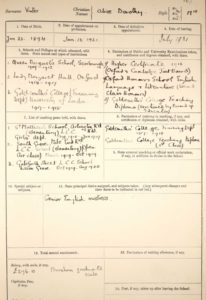
Meanwhile, my own searches in newspaper archives, (Find my Past), revealed a photo of Dr. Vinter which I sent to Lydia at St Lucia. In return she sent me a copy of Dorothy’s impressive CV. (right) and information that Dr. N.S.B. Vinter, a surgeon at the island’s hospital in 1925, had also been involved in the founding of their local Girl Guides. (In Bristol in 1946 he was a District Commissioner of the Boy Scouts Association and County Commissioner of the St John’s Ambulance Brigade.)
Meanwhile, I had been finding more about Dorothy’s life. Born in 1895 as Alice Dorothy Baker-Stallard-Peroyne, (if I had been aware of that monicker in 1951 I would have been even more scared to contact her!), she was the daughter of Rev Slade Raymond Baker-Stallard-Peroyne, a Clerk in Holy Orders, and his wife Alice, at Westbury on Trym. The family left Bristol before 1911. Dorothy married Noel Vinter in London shortly before they went to St Lucia.
They were back in Bristol, Soundwell Road, Kingswood by 1939 with their two daughters and Edith Loeb, who may have been a German refugee. The three youngsters were schoolgirls.
This seemed to be the end of the road, but you should always expect the unexpected. A new player entered the arena.
I had some surplus photocopies of my other ‘juvenilia’ to dispose of and advertised them on the blog. A gentleman called John Balmond contacted me. Arrangements were made for him to call and collect them. Transaction completed, we chatted amiably. I wondered at his interest. When he said he collected books about Bristol, I suddenly had a brainwave. Did he have any Dorothy Vinter’s? He said sorry, he didn’t, but I explained my quest and he replied he had so many other books he would have a look through them to see if any contained the elusive photo.
I thought that perhaps this was out of politeness; he was a complete stranger, but to my surprise and joy, a week or so later, it was literally “Eureka!” He had found a picture of Dorothy.
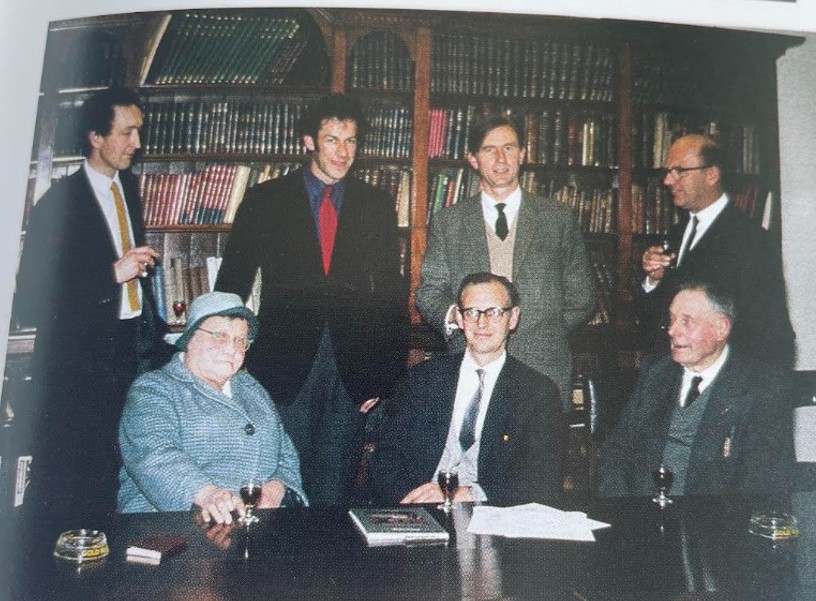
It had been taken at a scholarly meeting, 6.15 pm, 15 April 1970 in front of an impressive library, possibly at the University, with assembled men mostly younger, one even looking slightly roguish, and Dorothy, the only woman, aged about 75, very formidable in a hat and firmly buttoned coat. Every bit the retired head mistress.
Her hand on the table looks as if she may have been afflicted with de Kuyper’s Contracture, as I am. In front of her is an untouched wineglass of sherry as well as an ashtray. I wouldn’t be surprised if she smoked. Everyone did then. It aided concentration. No doubt the ceilidh started later.
If they weren’t dancing, then I certainly was.
Title Picture credit:
Reece Winstone, “Bristol as it was” 1970-80.
You May Also Like

Women and Mines
06 September 2026
My life on the Ocean Wave: â ...
02 September 2026
Bristol Women – Helen ...
01 December 2025
Leave a Comment
About Me
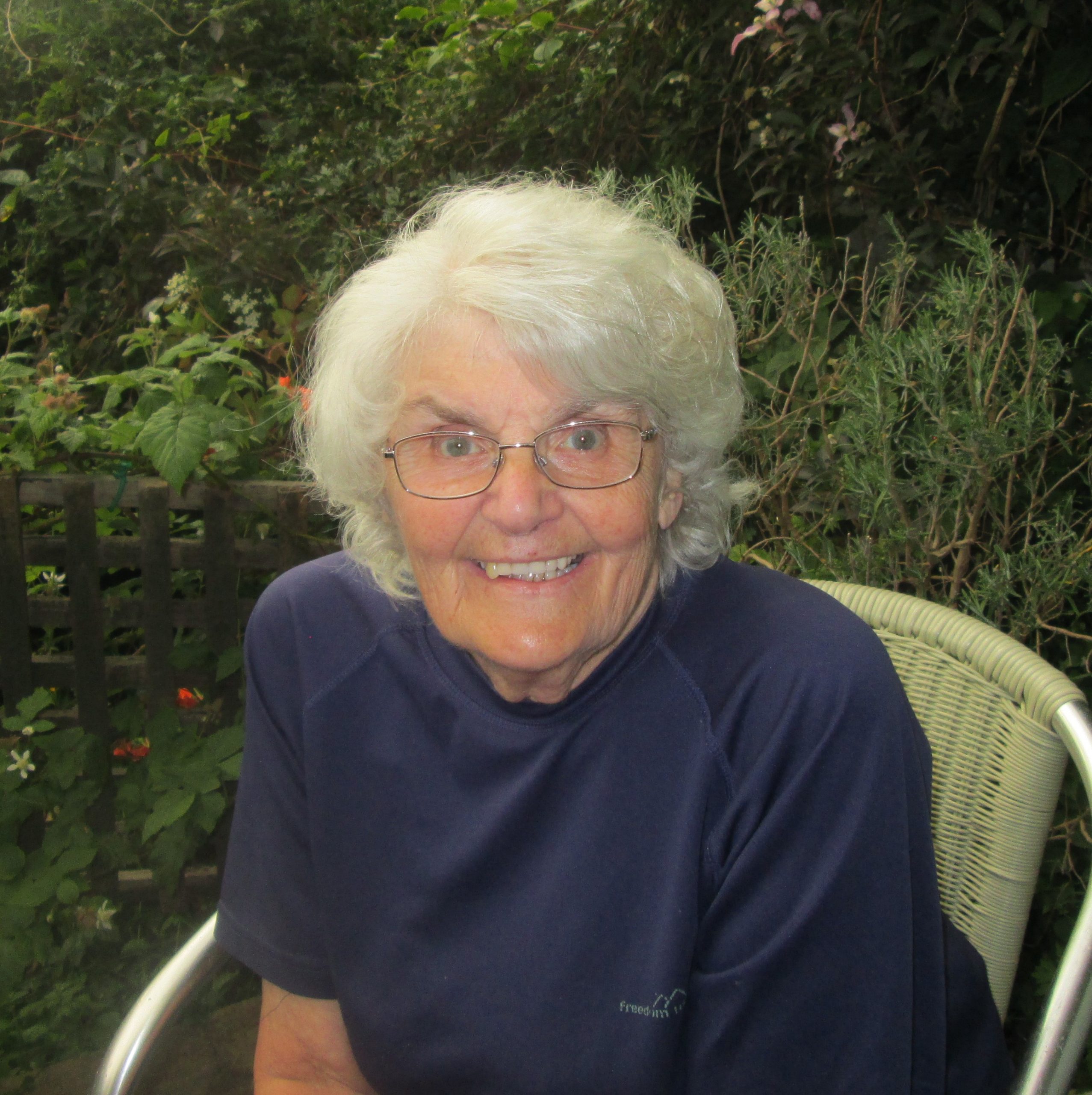
I have been researching the social history of the West Country for 50+ years. During this time I have collated information on a wide range of people living and working in the West Country including miners, ethnic minorities, petty criminals, sailors, tommies, benefactors, brassmakers and many more. The thing that I find amazing is that ordinary people always lived extraordinary lives. I hope you like my blog that brings together my lifetime of research.
Popular Post


Correction: Attention Fray researchers!
22 October 2026
BOOK BINGO! Dear Reader – “I went all in!”
21 October 2026


Blog Comments
Lydia Charlemagne
2nd September 2026 at 4:05 pm
Wow! Interesting. I thoroughly enjoyed reading this well-written piece. Dorothy Vinter was a remarkable woman, and I still hope that a photo of her younger self emerges. I live in hope.