

They say that in the Navy the girls are very fine
Some like Betty Grable and some like Frankenstein
No! I don’t want no more a Navy life
Gee but I wanna go, but they won’t let me go, HOME.
(A rowdy song with a multitude of verses I first heard aboard TS Foudroyant. Betty Grable was a famous Hollywood film star in the 1940s/50s.)
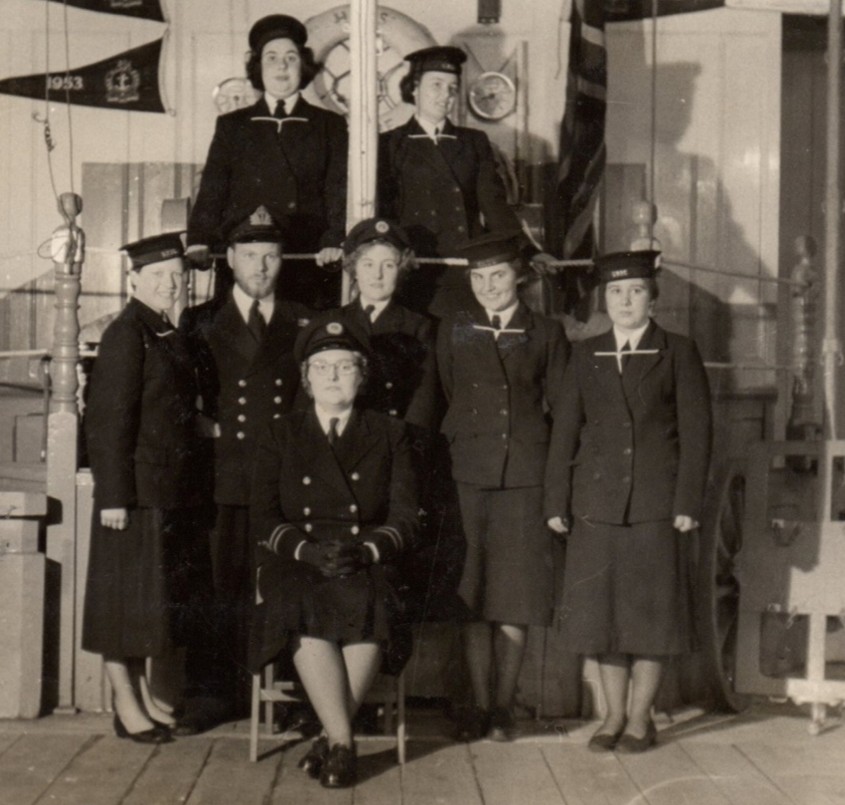
This is a piece of my own history. Sometime in 1953/4, Mum, (Florence Pillinger) noticed a small ad in Bristol Evening Post which read something like: “Recruits Wanted for the Girls Nautical Training Corps. Apply Thursday evenings, 7 pm, TS “Lotus”, Charles Hill Dockyard.” She was always looking out for stuff that would get me out of my malaise. This time I tingled with anticipation. That was for me. I could already feel the salt spray in my face and the wind in my hair.
The GNTC was formed in 1942 with sister organisations the GTC (Army) and the WJAC “Jacks” (Airforce) which had the same objectives as the cadet forces for boys. The Motto of the GNTC “Ready to Serve” needs no other explanation. The girls were to be taught the same seamanship skills that the Sea Cadet Corps taught boys. There were 50 GNTC units by the time I joined.
 Alas for my romantic notions. TS “Lotus” was “a stone ship” firmly aground and there was no boat in which to put to sea, but both cadets and officers were friendly as were the officers; the pretty blonde Mrs. Kingsley, and Mrs. Champion, who was tall, dark and elegant, and took me under her wing. She was possibly nee Dorothy Dungey, a surname which has a long history of Bristol seafaring. Mrs Champion favoured the Merchant Navy over the RN. Mrs. Kingsley was married to Julian, original name Wu. They wanted to emigrate to Canada but were refused entry because he had been born in Red China. There were also two spinster ladies, known collectively as “the Maltbys” who wore mufti of twinset and pearls.
Twenty girls lined up in two “watches”, port and starboard, “tallest on the flanks, shortest amidships”, with the officers in front of the big ship’s brass bell and a flagpole, where the red ensign, would be “bent on” for “colours”, the start of the evening, and “sunset” when we dispersed. I was in Starboard watch.
I learned a few knots and was kitted out in a heavy serge uniform: navy blue skirt and jacket, white shirt, black tie, black stockings, a white lanyard and a round sailor hat, with the letters GNTC picked out in gold on the black band. Shoes were our own, sensible, polished black, with laces. The officers, addressed as Ma’am, had to be saluted, “shortest up, shortest down”, never without wearing your cap. (Anything else was sloppy, cringeworthy. American!) I was so keen to receive my Ordinary Cadet armband that I never missed a meeting and one dark January evening when the buses from Kingswood stopped in Old Market Street due to snow, I tramped all the way to the Dock Yard, where SS Great Britain is now. I can’t remember how I got back. Probably walked then too.
 On Remembrance Day we would form march to the Bristol Cenotaph for the service; on the nearest Sunday to Empire Day we would march through Bristol with our sister unit from Avonmouth, behind the band of TS “Adventure”, the Sea Cadets’ unit.
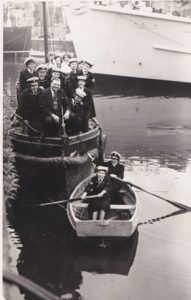
It was our dream to get a boat. Eventually, Mrs. Champion found a small rowing boat, which we called “Lotus Bud”. She was a tiny craft, taking only four people. We raised money for repairs through jumble sales. By the summer she was seaworthy.
“The Bud”, of course is the little rowing boat with a cadet and a Chief Petty Officer, possibly Miss Price, with the oars. The rest of us are crammed aboard a launch moored in the dock. I don’t remember who the man is, perhaps from the Council or Charles Hill’s Dockyard. I am to his left in the foreground with my head down. Mrs. Champion is standing towards the back behind the two Petty Officers.
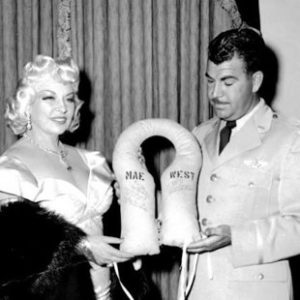 Before we could take “The Bud” out in the dock we had to undergo a “wet bob” test to show we could swim. I couldn’t even manage a length, and still can’t, so I’ve no idea how I passed. We were supplied with “Mae Wests”. (Mae West, what a sport and what a way to gain immortality! Her namesake saved the lives of many an Allied airman in WW2.) Ours were more primitive than in the photo, a couple of black inflatable inner tubes fastened together did the trick. I don’t recall any talk of extra safety. Can you imagine nowadays a crowd of teenage girls with little previous experience of rowing, (paddling) up and down Bristol Docks from Charles Hill’s to Hotwells where HMS “Flying Fox” was moored? Nobody drowned or even fell in, but once in a more sophisticated boat we had a race with some Teddy Boys. We won! Another day we nearly rammed a new vessel of Charles Hill’s called “The Queen Mother”. Luckily, no harm done.
One summer we joined Avonmouth cadets to re-enact “Crossing the Line” at the Shirehampton Fete. I was Amphitrite, goddess of the sea, my cheeks streaked with green gunge, with seaweed in my hair and wearing a long shroud. I imperiously ordered my “Doctors” to give a dose of jalap to three cowering Sea Cadets in drag. When they were pronounced free of tropical diseases, they were ducked in a canvas tank filled with water. The boys gave their names, Arry Ticker, Captain Bones, Lofty Heights, Jack Tarnished. People actually came to watch this nonsense.
Signals were my thing. In London for “Anchors Aweigh”, a bossy officer with a clip board spotted the crossed flags by then on my arm and thanked me for “volunteering” to raise the colours. I had done it loads of times before, but there was a large crowd assembled to see Admiral Lord Louis Mountbatten, the guest of honour. (His daughter Lady Pamela was our Commandant. I met her once, in awe of her poise and immaculate hair and make-up. Her uniform was of fine material, beautifully cut, nothing like our scratchy serge.) On the present occasion, gibbering with nerves, I began to raise the ensign. To my horror I saw I had “bent” it on upside down, the signal for “I am in distress”, correct, but unintentional. In panic, I hauled the thing down, detached it, and started again. The second attempt went without hitch. In his speech, Mountbatten, looking fixing me with glittering eyes, congratulated the ship’s company on the “excellent signalling”; my heart sank into my lace-up shoes. I turned beetroot. A few years later he was assassinated by the IRA. I did not remember him kindly, but he didn’t deserve that.
When I went to live in London a few years later, and knew nobody, the GNTC provided me with a lifeline. I joined the Kilburn Unit, and every Wednesday I changed into my uniform after work and took the tube to Kilburn, where Mrs Doris Goddard, the kindly mother of Barbara, the C.O, cooked my tea, usually egg and chips or bacon followed by banana and custard. Barbara’s sister Anne was also part of the Ship’s Company. Doris asked me one day why I didn’t join the WRNS as I was so keen on naval matters. I said I doubted I would pass the medical. “Got something wrong with you then, have yer?” she asked. “Back,” I replied. “Oh,” she said, taking hold of my shoulder and pulling me round to have a close inspection. “Hmm,” she said, “same as Anne, but honestly, I’ve never noticed yours.” I was surprised about Anne, as I had thought she just stood badly, but in fact her Scoliosis deformity was more serious than mine, one rib being joined to another horizontally with part of her lung laid bare.
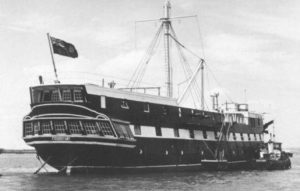 Once a year the GNTC took over the “Foudroyant” an old ship of the line, one of Nelson’s flagships, formerly called the “Trincomalee” which was moored in Portsmouth Harbour. Places were highly sought after and secured by ballot. I was fortunate enough to be selected, though in the end it was touch and go whether I would be allowed to take part; I was just out of hospital after emergency surgery to remove my appendix. This was a big deal then and even though my stitches were out I was supposed to be convalescent for at least another fortnight. Mum and Dad had to sign a document (in case I burst) that I went “at our own risk”. I’ve still got the scar. Luckily, I would never want to wear a bikini.
When the great day came, I took the train to Portsmouth and mustered on the main deck with representatives from GNTC units from around the country. I knew a few of the girls from Avonmouth, as well as several from Kilburn but none were from the Charles Hill crowd. We soon changed out of uniform into bell-bottomed trousers, sailor shirts with a square neckline and navy-blue jumpers.
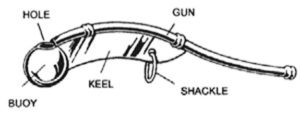
At night we slept in hammocks, which we had to “lash up and stow” at six a.m. sharp before a cold-water wash in “the heads”. Then we had seamanship classes or took up oars in the whaler for “the regatta” which was held by tradition on the day before we went home. As a signaller and “bosun’s mate” for the occasion I had to pipe any visiting dignitary aboard, probably the mayor. No fumbles this time. We were also encouraged to climb up the mast into the rigging but very few managed it.
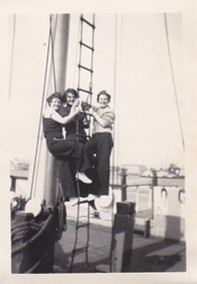
Me, (middle), with Helen Rusk, left and Audrey Felton, Kilburn’s CPO, on Foudroyant’s mast. We were called by our surnames.
On the last night we attended a dance ashore on the RN boys’ training quarters, a “stone” ship. We wore our uniforms with the white lanyards stretched across the lapels. The officers, ours as well as theirs, entered the spirit of the occasion by putting on full evening dress uniform. I still have my cap ribbon with “TS “Foudroyant” in gold lettering. One day, “on shore leave” in Portsmouth town, my sea-legs swaying beneath me, I absent mindedly put my cap on back to front. A passing sailor, a real one, yelled out, “You’re going astern!” Cringe. I turned beetroot again.
 My stay aboard “Foudroyant” coincided with the Suez crisis, and all the talk had been about the possibility of war. Many of the girls had sailor boyfriends and were in a state of panic. Anne Goddard’s boyfriend Andy Maxwell had joined the Royal Navy as a boy sailor and had been counting the days and hours to the end of his seven-year stint. This went for the proverbial burton. Five days after the UK, the French & Israel invaded Suez the USSR invaded Hungary. Nobody was demobbed that year including Andy.
When I returned home to Bristol, I went back to Charles Hill’s Dockyard to find the Unit seriously depleted. No longer Mrs. Champion or anyone else there I knew. By then I was too old to be playing sailor girls, and though I became an officer for a little while, I no longer really belonged. I tried to join the WRNVR on the Flying Fox, but they turned me down, as I had suspected, owing to my back deformity, citing “insurance concerns”. (It was probably for the best. I could not have stood the discipline. My husband has often called me a mustang.) Once again, I was bored and restless. I handed in my uniform, my lanyard and most sadly of all, my bosun’s call.
Looking back, for sheer fun, my days with the GNTC were some of the best of my life. Some Bristol surnames I remember were Foale, Miller, Crew, Sheppard, Shappland: first names unknown, – I wondered suddenly if “Shappland” could be the late dedicated Bristol Industrial historian Maggie, B.E.M.? That would be strange. Maybe not as she was ten years younger than me. The subject of the GNTC never came up. There was also Elaine Evans and two girls called Harris, Margaret, and Lyn, whose brother Dick was a sea cadet; Phyllis Gibson; Petty Officer Anne Edwards of Avonmouth. What happened to them? If you know please share the information.
 Anne Goddard of Kilburn who had also wanted to join the WRNS but would say, “No, I can’t,” ashamed, as I once was, because of her own scoliosis; when I last heard from her, she wanted me to join her in the Mediterranean where we had the chance to crew a sailing yacht. Mum was not impressed. She was fed up with me disappearing every so often. She said tersely through pursed lips, “I shall let your room!” Anyway, I was skint, so had to refuse and get a job. In June 1956 Anne married Andy Maxwell so perhaps she never went either. Barbara Goddard, our C.O. married Gwylym Brinn in 1958. They were good people and very kind to me, especially their mum.
In 1957, Audrey Felton married a chap called Henry Morris. As the marriage was registered at Chatham, I assume he too was a sailor.
Marjorie Angus, who I called Sprog” because at 14 years old she was the youngest of us on board “Foudroyant”, may be the woman of the same name who married Kenneth Greatbatch in Sunderland in 1984, long after our life on the ocean wave.
Maria Fairney, born in Cardiff in 1940, who had introduced herself with “Call me Butch!” was a tomboy. (I was reminded of her by Bristol’s England rugby player, Hannah Botterman!) Butch was tremendous fun. Without any warning at any given time, she was likely to holler “Three cheers for Butch!” in a deep foghorn voice.
The Kilburn Ship’s Company: Back row: name forgotten; Audrey Felton. Middle row: Helen Rusk; Lieut. Curtis (occasional male instructor); Anne Goddard; Me; name forgotten. Front: Barbara Goddard (CO)
I am sorry to say that I lost touch with them all. Most of them will be climbing the rigging in the sky now.
The GNTC itself was absorbed into the Sea Cadet Force in 1992.
You May Also Like

Women and Mines
06 September 2026
Miracles take a little longe ...
29 August 2026
Bristol Women – Helen ...
01 December 2025
Leave a Comment
About Me
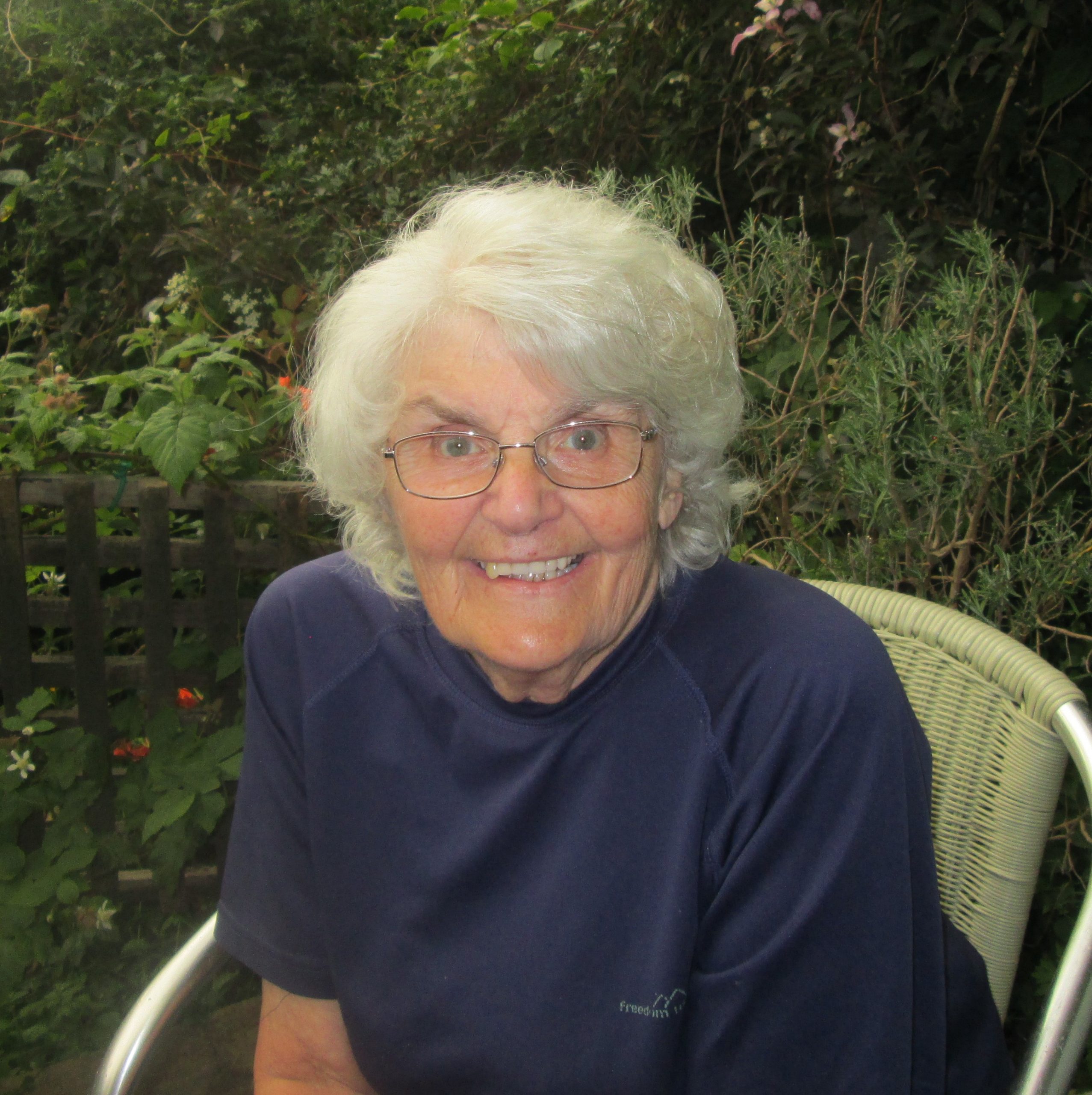
I have been researching the social history of the West Country for 50+ years. During this time I have collated information on a wide range of people living and working in the West Country including miners, ethnic minorities, petty criminals, sailors, tommies, benefactors, brassmakers and many more. The thing that I find amazing is that ordinary people always lived extraordinary lives. I hope you like my blog that brings together my lifetime of research.
Popular Post


My life on the Ocean Wave: “Some like Betty Grable….”
02 September 2026
Miracles take a little longer: Dorothy Vinter and me.
29 August 2026

Blog Comments
Doreen Lindegaard
6th September 2026 at 12:06 pm
The secretary of Bristol Sea Cadet Corps told me a while ago he NEVER KNEW THERE WAS A GNTC !!!
The Sea cadets send me their newsletter though: newsletter@ms-sc.org
I’ll tell them the blog is up.