

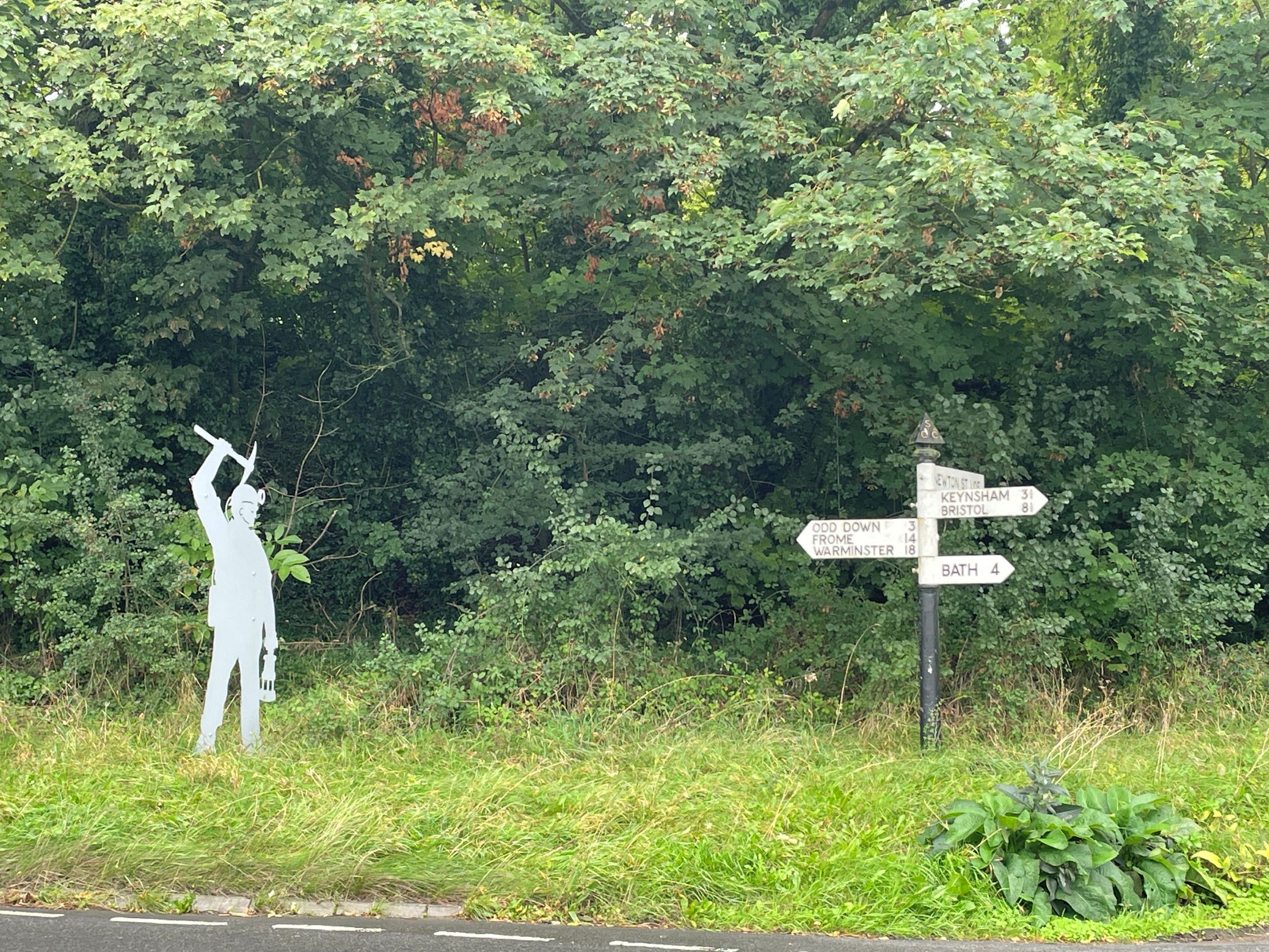
On Saturday, 19 September 2026, my son Kevin suggested a trip which involved little walking but with a few hours driving around north Somerset’s villages.
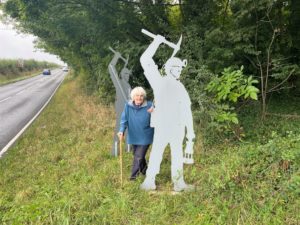
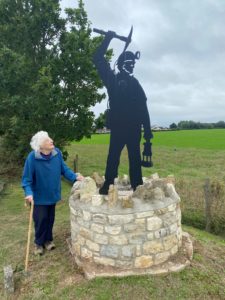
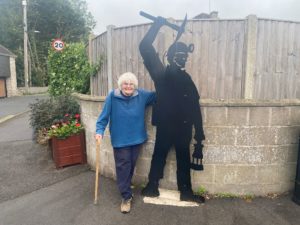
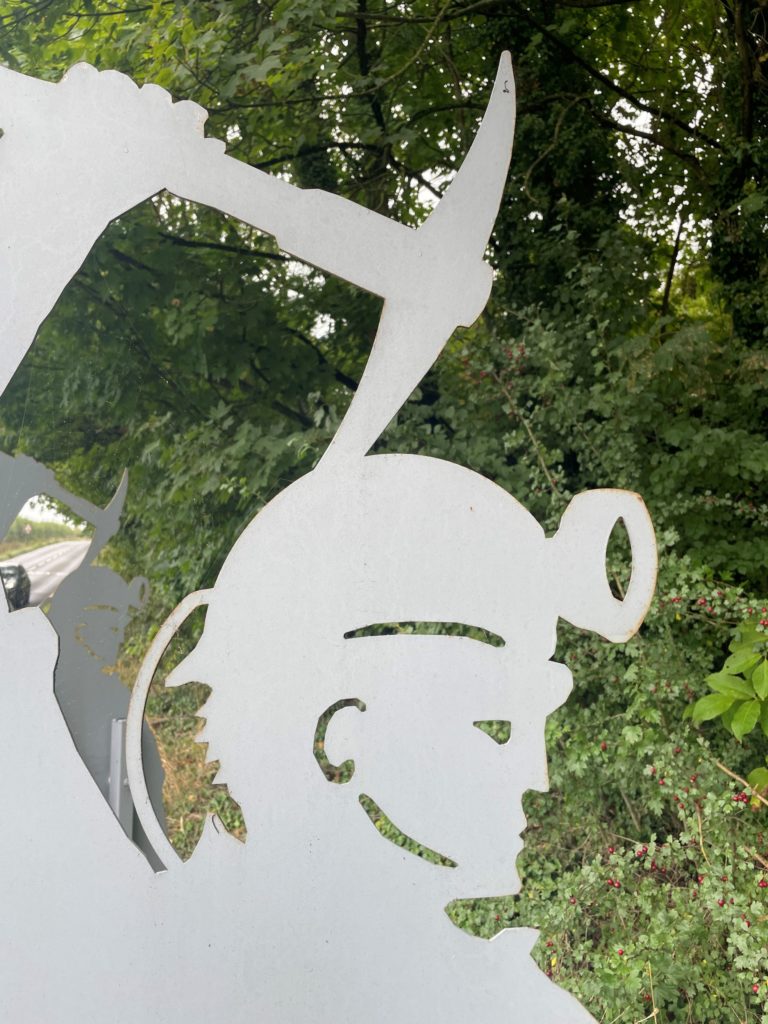
The Somerset Miners’ Welfare Trust has commissioned a series of metal silhouette collier sculptures, (artists Dave & Kate Speed), which have been erected at the roadside near relevant Mendip villages to commemorate the rich mining history of the region and to mark the 50th anniversary of the closure of the last two coalmines in Somerset.
As far as I am aware no factual coalminer is named with the silhouettes, but those who know me are aware that my business is naming the individual rather than an amorphous mass of humanity, so I researched a random collier (and one woman) associated with each of the seven villages we went to.
Tunley: LESLIE MITCHARD
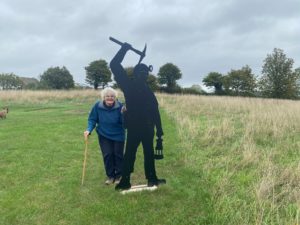 Leslie was born 20 December 1903 and died in 1996. His father George, an under-manager at Tunley pit, took him below ground to work aged fourteen. Accidents in coalmines were a regular occurrence, but those considered “minor” often hardly merited even a line in a local paper. Leslie Mitchard’s accident was one of those.
Carbide was issued to each miner which they took below in a small container to light their lamps. One of Leslie’s jobs was to go down the pit each morning at 6 a.m. to give out the carbide from a 2cwt drum. During his absence one day through illness, the job was done by someone else who appears to have left the top off the drum. Moisture escaped as a gas. On his return Leslie went down at 6 a.m. as usual
“When I opened the door that sucked the gas out, it ignited and I caught the full force of it in my face. The flame from the explosion burnt the surface to the eye. It was treated by my father (he was a first aider) and in the hospital afterwards. The skin cracked across and peeled off like a blister. My father saved my sight by washing out with jugs and jugs of water. I was totally blinded for 6 solid weeks and for 6 months I had a bandage round my eyes. Eventually I got my sight back, which is very precious.
“Along with the loss of the sight, my face was badly burnt. They didn’t know much about skin grafting in those days but the doctors in the RUH in Bath had a go, and my face – as you see it at the moment – it came off here” – [at this point he indicated a part of his anatomy] “where skin to graft was taken from.
“I’ll never forget the first thing I saw. My mother cooked a dinner, and I used to fiddle about with a fork and find the hole in the pads and bandages on my face and push the potatoes and things through. The first thing I saw was young potatoes and green peas and quite honestly, it was the most beautiful sight you could ever see, and I shouted to my mother, ‘Mother, I can see!’ It’s terrible to be without one’s sight.”
Meanwhile, with the First World War raging, Leslie’s brother Stanley had joined the Seaforth Highlanders, and their parents, George and Elizabeth heard the news that he was in hospital with shrapnel wounds to his face and head. Later he received the Military Medal for bravery at the Battle of the Marne.
By the time peace came, the two young men, Stanley and Leslie, aged 22 and 17 were back to pit work, though at the census of 1921, living with their parents and sister Phyllis, 13, they are described “carting boys, out of work”. Their father, still working, was “Under-Manager, Priston Colliery Co”. The pit was at Tunley.
In 1939, Leslie, who was then “a stonemason, heavy work”, and a member of the ARP, lived at Odd Down, Bath with his widowed mother. He seems never to have married. Perhaps his facial injuries, the legacy of his boyhood accident, ruined his romantic chances. Leslie died in 1996 in his 93rd year.
(This account is taken from a conversation with Mr. Mitchard and members of the Greenhill History Group at the Leonard Cheshire Home, reproduced in Look! This was Timsbury. The full transcript can be read on the Timsbury Community website https://timsburyparish.gov.uk/ with acknowledgements to the Community and the Cheshire Home.)
Before leaving Tunley, I include REBECCA WYATT, born Rebecca Pridy c1811 at High Littleton, who married Francis Wyatt, a coalminer, in 1833. In 1851 they are recorded at High Littleton with six daughters aged between 17 and 6 months old. In 1861 they were living at Farmborough, (at a place I cannot decipher, possibly “Stonbrow”?) with only two daughters at home, Hester aged 22, a servant, “subject to fits”, and Arabella, a scholar, aged 11.
The Western Daily Press, 9 November 1864, which does not name Rebecca, (as is often the case) but identifies her through her husband, states she was the wife of Francis Wyatt, a coalminer of TUNLEY. She had driven a small cart, laden with coals into Bath, with her husband and dismounted to remove a basket, presumably full of coal for delivery, when she was crushed between her cart and a passing brewery waggon. She sustained fatal internal injuries. An inquest report, verdict “accidental death”, (Bath Chronicle, 10.11.1864) states her name as Rebecca.
Though women did not work as miners in Somerset, I include her as an addition to the Tunley sculpture because evidence of women outside the domestic sphere is hard to come by, and Rebecca’s sad misfortune must surely show that she could not have been the only wife involved in her husband’s coalmining work.
In 1871 Arabella their youngest daughter, then 20 was “in service” for Daniel Stent, a Bath silk merchant and family, where one of her older sisters, Eliza, 33, was a cook. Of the rest, including Francis, their father, I have found no further trace.
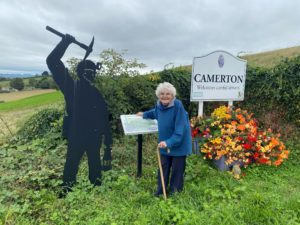 Camerton: JOSEPH GARRATT
For me, this is no contest, for it features the testy, square peg in a round hole, misunderstood vicar, Rev John Skinner, the 18th century leader of Camerton’s flock in matters of spiritual guidance. It may sound strange, but he is one of my heroes. I love Skinner.
On 3rd January 1823, the vicar was brought news of a roof fall in the pit. Joseph Garratt had been rescued, but with a broken back. Skinner hurried to Garratt’s cottage where his first task was to clear out a crowd of chapel ranters, who believing the man’s “time was near”, were exhorting him to repent his sins. Joe’s “sufferings were beyond bearing.” Skinner called them fanatics.
But Garratt’s time, unfortunately for him was not near. For ten months he lingered, paralysed, with Skinner fighting his cause against the egos of rival surgeons, including a painful operation to allow him to urinate, until, mercifully, the man died on 8 November 1823. (For the full account read ‘John Skinner: the Journal of a Somerset Rector.’)
Skinner was less sympathetic concerning Garratt’s widow, nee Sarah Osborne, who he called “that bad woman”. She had remarried by 1827; the vicar suspected her of diddling the parish Poor Law out of 14 shillings a month.
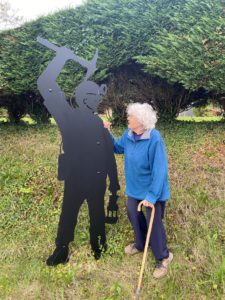 Pensford: Mr & Mrs Everyman. ERNEST (“MICK”) FRICKER, and his wife nee DORIS BEACHAM.
The Frickers celebrated their Golden Wedding Anniversary in comfortable surroundings in 1989, a far cry from the tiny cottage with no electricity and no mains water in which they began their married life at Clutton where Doris was born; she was the daughter of Arthur Beacham, a coalminer, (a hewer, a skilled senior in the underground workforce) and his wife Alice. At this time, Mick, of Timsbury, was working at Pensford Colliery, where coincidentally Doris’s father also worked, though the couple met at a dance.
The Frickers were a family of hewers, dating at least from Grandfather Samuel, born 1895, who was married to Elizabeth. By 1901 they had had a family of seven children, (Daisy was the lone girl among sons.) Albert, Ernest’s father was then 13, working underground as a carter alongside his elder brother George. By 1921, Albert, by then a hewer himself, was married to Ethel and Ernest, their son was six. By 1939 Ernest, now also a hewer, was married to Doris and they were living at Clutton Hill. At this time, Ernest, (now known as “Mick”) was working at Pensford. Subsequently they moved to a council house, built for miners, at Chilcompton. Mick worked at different collieries until 1970 when he suffered an (unspecified) accident at Writhlington, and gave up mine work, for Purnell’s, the printers, at Paulton, where Doris herself worked. In retirement Doris, despite arthritis was a keen knitter. Mick was an all-round sportsman, football, tennis, played cricket for Stratton on the Fosse, and finally umpired at Downside School. They had four children, eight grandchildren and a greatgrandchild. (see Shepton Mallet Journal, 17.8.1989)
Newton St. Loe: HENRY MERRETT
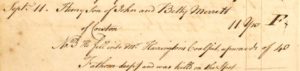
Henry, the son of John & Betty Merrett, of Corston, was killed falling down the coalpit at Newton St. Loe and was buried there 11 September 1774.
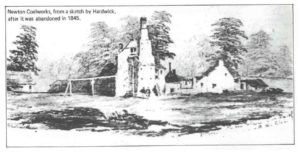
Newton St. Loe was among the older coalpits of Mendip. Coal mining began there in the 1730s and ceased in 1845.
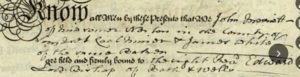
 John Merriott, coal miner, bachelor, of Midsomer Norton with James White of the same, baker, as bondsman, took out a marriage licence from the Bishop of Bath and Wells to marry Elizabeth Cowdell, spinster, of the same parish.
 The couple were married at Midsomer Norton on the 13
The bride was a “cut above” as unusually, she could write. She signed Betty Cowdell, though John made his mark. A marriage by licence, which avoided the need for “banns”, called on three clear Sundays in their parish church,  so avoiding local speculation, could also mean the couple were of a slightly higher rank. Furthermore, Betty was not “local”; Cowdell is not a Somerset surname.
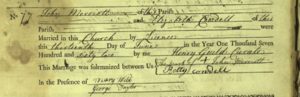 These two were the parents of Henry, born about 1763.
Henry Meritt/Merrett/Merriott is the first recorded of those who were killed in the coalpit at Newton St. Loe. According to the parish register he fell more than 40 fathoms to his death at Mr Harrington’s pit. I can find no evidence that John and Betty had other children.
 Boys aged seven and upwards were often at work in the mines, as their small size made them more appropriate to squeeze along the narrow seams.
Bath Chronicle, 15.9.1774, states: Sept. 13th “Friday evening the following melancholy event happened at the coal-pit at Newton near this city: Henry Merret, a boy of 12 yrs old, being as is supposed, asleep by the fire near the mouth of the pit, and one of the men at work calling him, he suddenly started up, and fell into the pit, near 60 fathoms deep, whereby he was so terribly bruised that he instantly expired.”
The newspaper report is ambiguous as to whether the boy was working at the pit – but he was at least sleeping, by the fire there. What brought about this sorry state of affairs is left for us to guess.
There is no ambiguity in the report quoted by Graham Davis in his masterly article in BIAS Journal no 10, 2021, ‘Coalmining at Newton St Loe’ quoting from Bath Journal 10 September 1804, “On Wednesday, a boy of the name of Kington, was killed in a coalpit at Newton. It is supposed a stone fell upon his head while eating his dinner at the bottom of the pit and killed him on the spot.”
https://b-i-a-s.org.uk/uploads/2021/01/BIAS_Journal 10_COALMINING_AT_NEWTONSTLOE.
Timsbury: GEORGE FLOWER
 First, two cuttings relating to Timsbury which illustrate the frustration of trying to name individual miners. Even with multiple loss of life their names were often not considered worth recording, or the local paper has not survived, but on occasion were picked up far afield from where they occurred: The first is from Derby Mercury, 20.11.1735:
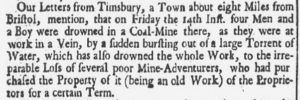
Please note that sympathy is with the unfortunate Mine-Adventurers and their business losses. There would not even be a parish register entry for those who drowned.
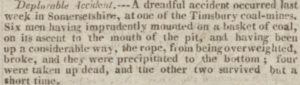
Sussex Advertiser 17.4.1815 reported six deaths at Timsbury pit. Here, the men were blamed for their own foolhardiness, (it was never that the rope was old and faulty) but the anonymity is the same:
 Fast forward to 6 February 1895. George Flower, the examiner, and John Fear, a general labourer, an assistant who was with him, survived an explosion at the Conygre Pit, Timsbury, which took the lives of nine men and boys. Though shocked, they did everything they could to assist the rescue operation. George Flower was the first witness at the enquiry (see Bristol Mercury 28.2.1895) and gave lengthy evidence. Fear agreed with everything he said.
Like the Flowers, the Fear family has a long pedigree in the district, but without other evidence to show which John Fear he was, I concentrated on George Flower who was born and lived his whole life in Timsbury from his christening in 1839, recorded in the baptism register, until his death in 1918.
He was the son of George Flower and Eliza (nee Kite, who were married at Timsbury in 1831), and in 1841 is recorded, aged 2, in the census, with his parents, sisters and younger brother Isaac, aged one. From then on, he appears in each census regularly every ten years, plus at the parish church for his two marriages, Eliza Hill in 1860, and after her death to Louisa Harding in 1895, a few months after the disaster.
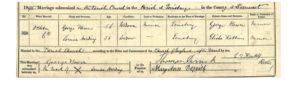
As a coalminer he followed his father, though not as early as some youngsters. The above certificate of his second marriage shows he was relatively well educated and could write his name in a neat signature. A long, but fairly uneventful life, I thought, and until the disaster, not very different from every other family, births, marriages, tiffs, bereavement, illness, major and minor, hard work, how to put food on the table, and for both Elizas and Louisa, the tin bath in front of the fire, and a lifetime of scrubbing black coal dust from backs and filthy clothes to wash. Which serves me right for expecting an easy few paragraphs about George Flower.
But….it turns out that George & Isaac had an elder sister, Harriet, who I had overlooked. On 2 March 1851, she married Jacob Windmill, a coalminer, at Timsbury.
In scouring the litany of the ordinary, I also forgot that many people made ends meet by taking lodgers. On 1 December 1851, George Bush, aged 36, a milkman, Mrs Eliza Flower’s lodger, went to a cattle auction at Priston to buy a cow but was disappointed. On his way home, he stopped at the Ring of Bells, where he had a drink with a butcher, James Evans of Farmborough, and two others. He left alone to walk a lonely footpath, back to Timsbury, in December, on a pitch-dark night. Bush had by all accounts told Mrs Flower to expect him the same evening, but when he was still not home the next morning, she sent her two sons, to look for him along his usual path. These two little boys were George Flower and his brother Isaac, aged 12 and 10 years old. It was not unusual for children to be sent on errands, any more than it would have been for me and my younger brother a century later. When they came to a field called Cow Lees, the boys came across Bush’s dead body.
The corpse, awaiting the coroner, was left exposed, and when the reporter from the Wells Journal arrived, it was surrounded “by a large concourse of persons”. He made the most of “the ghastly scene”:
“The wound had evidently been inflicted by a large sharp implement which entered below his chin, laying open the interior of the mouth and extending round each ear, the collar of the shirt completely severed in two. The villains had filled up the mouth with grass. Underneath the head was a large quantity of blood, a short distance away, his hat and another pool of blood, the intermediate space sprinkled with more blood. The trouser pockets had been rifled of their contents and turned out and on the back of his hand was a shilling affixed by the blood.” (Wells Journal 6.12.1851)
The boys must have been “frightened to death”. Their mother warned them that having found the body they would have to give evidence at the inquest but also mysteriously told them to “say nothing about the meat”, which muddied the water. The Bath Police quickly exonerated any of Bush’s relations and concentrated on the Flower family. It transpired that Bush was in possession of £6 from which he gave his sister a sovereign and “paid away” another ten shillings, leaving £4.10 shillings which Mrs Flower, his landlady, knew about.
The boys, George and Isaac, made statements about being sent by their mother to look for the body; that she thought Bush might have fallen over a stile and broken his neck; that she knew of the money he had on him the night before; about finding the body a mile and threequarters from where they lived; that she cried when she heard of the death. Even about the meat eaten which they were told not to mention.
Shortly afterwards their mother Eliza Flower, their sister Harriet, her husband Jacob Windmill and his fellow collier, Stephen Box, were all arrested on suspicion of murder, taken in charge and remanded in gaol.
A rudimental legal aid Act of 1836 allowed for an accused to be defended in court by a lawyer, but the poor who usually had no means to pay, generally went unrepresented.
In subsequent court appearances George and Isaac Flower appeared for the Prosecution against their mother, sister, brother-in-law and Box. They were questioned separately by the Prosecutor, Mr Williams, with the accused allowed to cross-examine.
George Flower, 12, started off well. He lived in Timsbury with his parents. He was at home on Monday evening. Harriet, his sister and Stephen Box were there and still there when he went to bed about 8 o’clock. He was not certain if Jacob Windmill was there. They had been talking money, about a pig for which a neighbour, Henry Offer had paid Bush seven and six. His mother said Bush had between four and five pounds.
Mr Williams: Was anything said about going to meet George Bush?
Witness: Mother said she had a mind to send Stephen Box to meet him.
Mr Williams: Was anything said about Windmill going to meet him?
Witness: Jacob said he would not go if Harriet did.
Mr Williams: Did Harriet want to go?
Witness: Yes.
George then retold the story of being sent with his brother to look for Bush, of finding the body and his mother crying. He saw Jacob Windmill about two o’clock the day after and told him to go down to the ground. Windmill said, “What Ground?” and George answered, “the place where Bush was killed.”
Witness: Jacob seemed frightened by that……he didn’t say he was afraid……he was trembling all over. Jacob slept at his mother’s house that night which he had not done before.
George rambled on, volunteering that the meat they had for supper belonged to Jacob, though Bush also kept meat in the house. His mother told him he would have to go forward as a witness because of finding the body but not to say anything about the meat they had for supper on the Tuesday.
The prisoners were told they could ask questions.
Jacob Windmill: He has told ever so many lies. Was I at your mother’s house on Monday evening?
Witness: You were there on the night we had the supper. When you said you would not go (to look for Bush) unless someone went with you.
Mr Williams : Was he there on the night he said he would not go to meet George Bush if Harriet did?
Witness: (after remaining silent for some time), I think he was, sir.
Windmill: Did I say I would not go if Harriet did?
Witness: I heard somebody say so. I thought it was you.
Prisoner: What was it your mother said to you about the meat?
Witness: She told me to say nothing about it.
Harriet Windmill then questioned the witness, stating on her own behalf that she had gone to her mother’s house for a pint of beer for her husband, that she wished them goodnight and went home. The witness (George) had gone to her next morning and told her Bush had not been home, and he was going to look for him.
Eliza Flower said all that George) had said about Jacob Windmill and the meat was wrong.
Witness: It was either Mother or Harriet who told me not to say anything about the meat.
Either way, George was in trouble. He looked like a an unreliable witness.
His little brother Isaac took the stand. He and George had been together the whole time.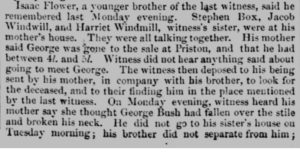
Mr Williams: Tell the magistrates what you told Mr Hughes.
Witness: I don’t recollect what I said.
Mr Williams: Did not your mother tell you to say Jacob Windmill had not been in your house on Monday night?
Witness: Yes she did.
Williams: More than once?
Witness: I don’t recollect.
Williams: Did she not tell you so when you went before the coroner yesterday?
Witness: Yes Sir
Williams: What did she say?
Witness: the same as on Monday
Williams: What was that?
A Mr Taylor intervened: What was that?
Witness, after much heistation. Mother told me not to say anything about Jacob being in the house on Monday night.
Williams: Mother told him not to tell anyone he had meat for supper on Monday evening. She did not tell him that it was Jacob Windmill’s meat. Jacob and Bush both had meat at the house
Windmill: Did you say I was at your house on Monday?
Witness: Yes. You were there between four and five and came back at 7 o’clock.
Harriet Windmill then cross-examined the witness (Isaac) with a view of proving her husband had not been at the house on Monday evening. The witness became very confused and prevaricated when giving answers.
This was the whole of the evidence against the prisoners. The witnesses were called in to listen to hear it read to them and sign their depostions.
George Flower: I remember now. Jacob Windmill was not at the house on Monday evening.
Mr Taylor: Then all you have said before is untrue?
George: It was Sunday and Tuesday he was there. Stephen Box was there on Monday.
Isaac Flower also stated he had made a mistake. Jacob Windmill was not at their house on Monday; before he thought he was, but now he recollected it was Sunday.
Williams: Where was George Bush on Sunday?
Isaac: I don’t know.
Williams: Was he not at home?
Isaac: I think he was.
After this farrago, the prisoners were remanded, but then released. James Evans, the man who had been drinking with Bush in the Ring of Bells became a suspect, but was also released. An Irish hawker, inconveniently named John Smith, confessed in 1852, but as he made a habit of pleading guilty to murders, even claiming responsibility for the Irish Potato Famine, he was adjudged insane.
The case seems strangely preoccupied about whether Jacob Windmill was or was not in Eliza Flower’s house the night of the murder. Did anyone ask Windmill the obvious question? If you weren’t at the house on the night of the murder, then where were you? One or all of them possibly got away with murder. If not, the meat was a red herring which had been nefariously come by or belonged to Bush and they were trying to cover up that it had been eatrn. It all smacks of “Don’t mention the War!” The one thing the boys had been told not to mention, but of course couldn’t help themselves saying it.
No-one was ever brought to justice for the murder of George Bush.
Amongst the voluminous proceeedings involving the Flower family and friend, there is a notable absentee: George Flower senior.
He was in Bath. He had been in poor health, unable to work for sometime and was dependant on a club for a weekly allowance. He was an out-patient of Bath United Hospital and in lodgings in the city, but usually returned on Saturdays. There is some evidence that both his sons had seen him before the hearings and he consequently coached them in their evidence. Whoever thought that “No comment!” was a modern invention? “I cannot recollect….” was its older ancestor.
In the 19th century, an inventor took advantage of the new craze for electricity. He was publicly thanked in a letter to The Globe newspaper:
Galvanism v. General Weakness and pains in chest
“Timsbury, near Bath, April 24, 1878
Dear Sir, – I have been entirely confined to my bed for nearly four years from a weakness in the chest and general weakness. Having heard of your chain bands through a friend, sent to you and got one; at first I gradually began to impove and have been improving since. I am now able to dress myself and go about the house without help. Believe me, I am most gratefully yours
George Flower
To J.L. Pulvermacher, Esq.
Pulvermacher’s Chains were widely popular; battery operated, they sent a mild electric current through the wearer. The chain allegedly “cured” any number of illnesses. Charles Dickens himself had one for a sore foot.
George Flower senior, died aged 73, and was buried 22 March 1880. George his son was buried in 1918.
High Littleton: GEORGE MAULE
From his census details, George was another who led a quiet regular life at the colliery. Then, this newspaper obituary in the Somerset Guardian, 15 May 1964, caught my eye.
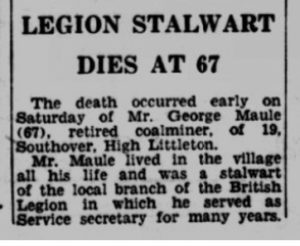
George Maule, sometimes spelt without the final “e” was born in 1897, the son of George H. Maule, “coal gallery incline man, below ground”, 26, and his wife Emma, aged 30. In 1901 aged four, George junior was living at Ratcombe, High Littleton, with his parents and younger brother and sister, Ernest aged 2, and Eva, 2 months old. Next door lived George senior’s brother, Joseph aged 32, a hewer, who was married to Louisa.
 By 1911, the family had increased; there were four more children, Gertrude, Rosamund, Winifred and Alfred. George senior, by then 35, was a “coalminer, runner”) and George, junior, now a big boy of 14, was a carter at the pit.
In 1921, “young” George, now 24, still lived at home. Both he and his brother Ernest were hewers at Greyfield Colliery, but unfortunately were both “out of work”. Their father George H. was still in work as a hitcher at Greyfield. Two more children had been born, but others were missing.
In 1939, George, now aged 42, colliery hewer, below ground, was with his wife Olive and daughter Gertrude, (named after her aunt), now Mrs Hillman, and her two children.
I had wondered about his allegiance to the British Legion, and more cuttings which indicated he was the flag bearer and led the processions at local ceremonies.
After which all was revealed from “Lives of the First World War” on Find My Past, to whom my grateful thanks.
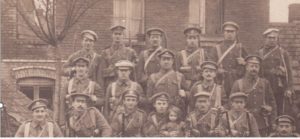
George, with a 1914 Star among his “Pip, Squeak & Wilfred” medals, was a Corporal in the Royal Engineers, 179th Company serving in Western France. George is in the back row, second from the right, photo taken in Albert, France, 1915.
Suddenly his young face stared at me from the computer, a photo taken in Belgium:
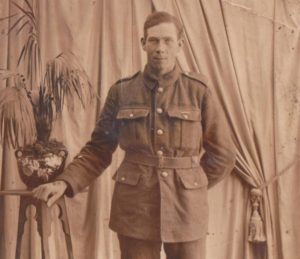 The 179th Tunnelling Company of the Royal Engineers was one of the specialised units formed from experienced miners and sewer engineers to dig underground tunnels below the German trenches. Tunnellers spent hours in total darkness, building dugouts and subways to allow the transit of large numbers of troops to the front line without detection and listening for intelligence using primitive instruments. If the sound of an enemy pick was heard – the Germans also had tunnellers – either side would detonate an explosion to bury their adversaries alive. This brings home the obscenity of war. By 1918 the British redeployed the tunnellers as field engineers, locating and disarming the delayed action booby traps the Germans left behind. Among the characters in the book “Birdsong” by Sebastian Faulks is a tunneller, Jack Firebrace.
Hallatrow: ELIJAH WYATT
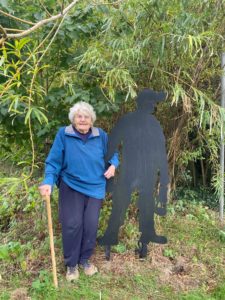
Hallatrow is a tiny village about a mile from High Littleton with its own effigy. The description “Elijah Wyatt, coalminer of Hallatrow” is well known in the district as there were several men with this name, father and son or uncle and nephew. I am sorry to say the Elijah Wyatts are chiefly notable for being poachers.
Elijah Wyatt, coalminer, born Hallatrow, born c1837, with a wife Sarah, who was born at Paulton, eked out his ten-bob-a-week wages by other odd jobs. On this occasion he was not a poacher. The tale is poignant.
 In the Frome Times, 18.1.1865, under the heading “A severe sentence”, Elijah Wyatt of Hallatrow pleaded guilty to cutting trees but not wilful or malicious damage, at a field garden he rented from Captain Scobell who in turn rented the same of W.H. Gore-Langton, Esq., MP. (Incidentally this shows the Gore-Langtons, Lords of the Manor at Brislington where I live, had substantial estates over the Mendips.)
The defendant, being paid yearly to cut the fences, be;oeved he was doing right. He was fined £2. 3s.0d including costs. He said, “I might as well go to prison, for I cannot pay it. I am a collier earning 10 shillings a week and have a wife and several small children.” The bench gave him a fortnight to pay.
By 1871 Elijah and Sarah had four children Mary Ann, 9, Elijah, 6, Elizabeth, 4 and John George, 2.
In November 1868, possibly the same E.W. of Hallatrow, was sent to prison for one month with hard labour for being found in enclosed premises near a hen coop belonging to Lionel Lippiatt, Esq. In April 1870 he was convicted of stealing a halter, worth 1 shilling and 6d and sent to gaol for six weeks.
George Wyatt and Elijah Wyatt, both of Hallatrow, (East Somerset Telegraph, 6.1.1872) were brought up from custody charged by the gamekeepers of the Earl of Warwick of being with a gun in search of game at Clutton, December last, and assaulting John Taylor, an under-gamekeeper. The crowded court was highly excited because a large mastiff dog kept by a gamekeeper was loose on the public road which allegedly had seized hold of Elijah and gave him a severe bite. This counter claim was abandoned by the prosecutor, but the second charge was proved. The prisoners were sentenced to one calendar month in gaol with hard labour and required to provide sureties of £10 not to reoffend within a year, or they would serve an additional six months.
On 22.5 1874, E.W. of Hallatrow was fined £5 for being found by the police at Hallatrow railway station with 31 pheasants’ eggs. Fined £5 with two months hard labour in default.
Or they were out at night. (Western Gazette, 2.4.1875) having been kept for trial since the previous November. They were imprisoned 9 months with hard labour.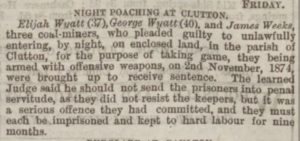
In another report the poachers had refrained from violence against the keepers though were armed with stones and a life preserver. (a truncheon).
With E.W. here described as 37, this makes him likely to be the son of George and Ann, baptised at High Littleton, 23 July 1837:
In December, Western Gazette, 1877, an E.W. was suspected of trespassing in search of conies. He had been convicted of poaching five times as well as other offences. He was fined £2 plus costs. Most of such offences took place involve foodstuffs by  some who had very little to eat against others who had far too much of everything. The is not to say the Wyatts were angels but if they liked a drop to drink which could get the better of them, who could blame them? In August 1873, E.W, James Wyatt, and Jonah Weeks, all of Hallatrow were sentenced to 14 days for being drunk and riotous and refusing to leave a beerhouse in Timsbury. Or even several times assaulted the police in the execution of their duty.
 In February 1877 an eviction order was issued against Elijah Wyatt to evict him from his tenement in Hallatrow, and another 3 October 1879 obtained by Mr Gore-Langton to evict Elijah from his cottage. Whether this is the same Elijah or another of the same is hard to say.
Having by then lost the will to live through any more of this misery, I turned to the Elijah baptised 29 November 1863, son of Elijah and Sarah.
This lad at sixteen was a collier like his father, and brother William, 12.
In 1885 “aged 18” he joined the Somerset Light Infantry. He was re-engaged in March 1891, wages £1.10s. No further military records survive for him, and he next appears in Bedminster, “born Hallatrow” as a coalminer. By 1901 still in Bedminster, he was working as a general labourer. He died aged 41 in 1905. His son, the latest Elijah, born in 1893, was working in a tobacco warehouse in Bristol in 1911 with two brothers and a sister, and Annie, their widowed mother.
Elijah Wyatt, grandfather to this boy died in 1918, aged 80, his death registered at Clutton.
—————————————————
Onward to another seven – only 21 to go. This year, next year, sometime never. I only used two who appear in “Killed in a Coalpit: Lives of the Mendip Colliers” because I like making things difficult for myself.
You May Also Like

Women and Mines
06 September 2026
I’m still here and wri ...
11 April 2026
Killed in a Coalpit updated
13 October 2025
About Me
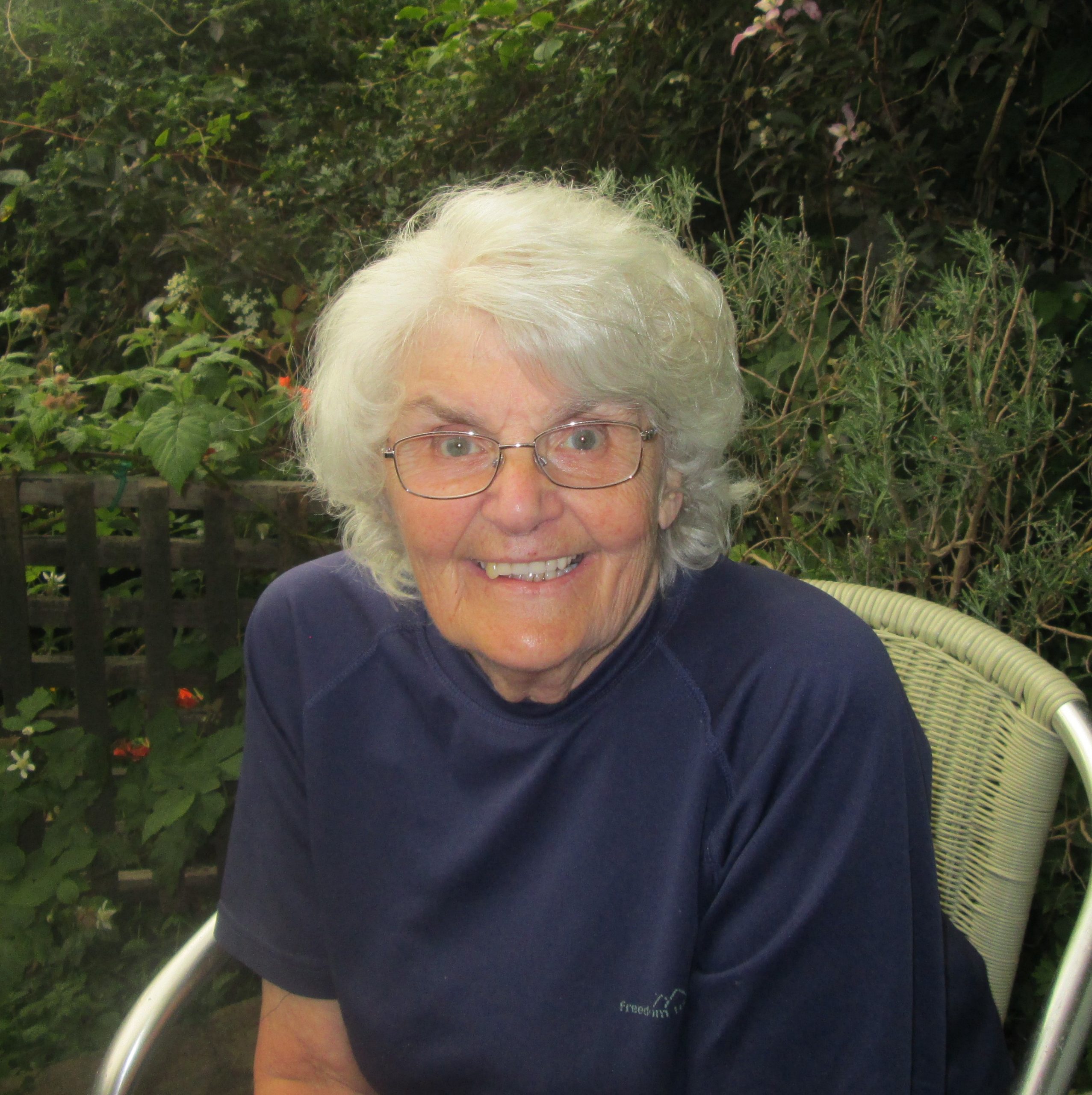
I have been researching the social history of the West Country for 50+ years. During this time I have collated information on a wide range of people living and working in the West Country including miners, ethnic minorities, petty criminals, sailors, tommies, benefactors, brassmakers and many more. The thing that I find amazing is that ordinary people always lived extraordinary lives. I hope you like my blog that brings together my lifetime of research.
Popular Post


Correction: Attention Fray researchers!
22 October 2026BOOK BINGO! Dear Reader – I went all in!”
21 October 2026


Leave a Comment